Wednesday, February 18, 2009

Navigating the Mighty Coyote Creek in San Jose

Advocates at Earthjustice today called on Congress to fix the Clean Water Act by eliminating the legislative loophole restricting the US EPA to only protect "Navigable Waters,"

Bush's Supreme Court had given his administration the legal basis to ignore water pollution at thousands of wetlands, streams and lakes and groundwater basins. A new bill has been introduced, called the Clean Water Restoration Act, which removes the word "navigable" and replaces the words "waters of the United States".

I noticed the Santa Clara Valley Water District has now begun to refer to the Coyote Creek as navigable. We are certainly witness to the flotilla of canoes launched under the smiling blessings of Admiral Spillman and her crew of trash photographers and recovery personnel. The next trash raft attack is scheduled for the weekend of March 1 if you care to join the war on creek trash.

But I have had personal knowledge that the Coyote Creek is navigable, acquired in the best possible manner, when Dan O'Brien and I ran the river at twilight one crazy evening in the winter of 1978. Dan & I were then young bucks in our early 30's, and tended to do outrageous stuff on a mere suggestion.
We were sitting on his deck at 311 Brookwood, Dan playing his guitar, watching a flood wave crest through the river as the sun was just about to set. Dan started playing "Dueling Banjos," the theme song from that infamous movie, "Deliverance". This adventure movie put running rapids into a whole new category. It also gave dam builders a slight reduction in the number of activists trying to stop dam building. Large dams usually inundate and destroy miles of rapids available for adventurous folks to challenge the river with their rafting skills.

But it didn't deter us when our testosterone-filled brains decided we needed to get to Mel Cotton's Sporting Goods store before they closed so we could purchase a six-foot inflatable raft and a couple of paddles. The good news is we made it to the store on time. The bad news was that the sun had already set by the time we got the raft home and inflated and were ready to launch our maniacal selves into the river at flood stage.


But the rain and river gods and goddesses wanted us to run the river this evening, as low clouds from the current storm hung low enough over the valley so that they effectively reflected enough street light on the creek that we could see where we were going. Beside getting the boat, our only other preparation was that we also told Dan's neighbor, Don Mathias, what we were up to and asked if he'd be willing to come get us if we were to survive this mad adventure.

So off we went down the river. The inflatable raft was sea worthy enough, although we would soon find out that only luck would keep us from getting flushed out of the creek and into San Francisco Bay. For the next two hours we paddled hard to steer the raft down the river, moving at about 10-12 feet per second, stopping again and again to portage around downed trees lying completely across the water.

The most beautiful memory of all this came as we passed one large tree growing near the bank that had about 25 white herons roosting for the night. Most of them saw us coming and took flight and flew around us as we passed their lodging and then resettled in to the tree as we floated by. Crazy humans!

Just as we were passing the Flea Market near Berryessa Road, we punctured the raft on one of the million twigs and branches we had floated by in the last three miles of the floodway, and this proved that the gods and goddesses were watching out for us during our nutty urban river rafting adventure.

We climbed out of the river soaked and covered with dirt and debris and knocked on the door of the San Jose Meat Company that was opposite the creek from the Flea Market and asked to use their phone to call Don for a ride. I think the people working that shift would not have dared to say no to these two wild men standing dripping at their door. I just hope we didn't contaminate any sanitary areas that we walked through to use the phone. (This is one more reason why cell phones were invented, so crazies don't show up at your door to ask to use the phone.)

While waiting for our ride, I walked across Berryessa Road and looked downstream at the river. Upper Penetencia Creek has its confluence with Coyote right below this bridge, and the flow downstream was greatly increased on north side of the road. But since agriculture fields still existed in this historically floodable area instead of floodable urbanscape like it is today, the street lights that had illuminated our evening rafting trip were non-existent downstream of the confluence and all I saw was white water disappearing into a black abyss.

I realized if we had rafted under that bridge, we might have been carried all the way to the bay, probably under rather than on the water. But instead, I am here on this bright and shiny Wednesday watching the sun set across the Coyote and glad I am still here to be a witness to the fact that Coyote Creek is indeed a navigable waterway, and right here in the middle of downtown San Jose.

I also hope this story brings a smile to my dear water brother Dan O'Brien, who is undergoing spinal surgery today, repairing damage done to his younger self, either playing basketball or doing crazy shit like I have just described here.

Blessed Be!

Monday, February 16, 2009

No Trash Dumping, Flows to the Creek

Some of my neighbors in the Campus Community in downtown San Jose recently posted a picture of a trash raft floating on the water surface in Mid-Coyote Creek, somewhere near the San Antonio Street bridge.

I posted a terse response to chide the comment that we should wait to see if the raft would move downstream before doing anything about it. The author was rightly miffed that I suggested her intentions might be indifference to the problem rather than waiting for a safer time to remove the raft.

After apologizing and giving a short history of the ignorance of this problem, I resolved to dedicate this blog post to pollution prevention of trash in our creeks. Consider this an extension of the work I did for my last eight years at the Water District as a contract employee running the Silicon Valley Pollution Prevention Center.

In my own personal experience, plastic bags are the number one candidate for eliminating a serious source of creek trash. Walking along the creek one day in William Street Park, I picked up 22 plastic bags that had blown into bushes along the creek from tables, trash cans and ignorant park users. This is not a new problem. In 1995, the Pollution Prevention Center started giving seminar attendees high quality canvas tote bags silk screened Take Me Shopping.

A few months ago, I found a web site dedicated to getting the Clorox Corporation to start recycling the plastic-cased Brita brand water filters. Threatening to embarrass this major corporation for its lack of producer responsibility and product stewardship, this month Clorox set up a nationwide network to collect and recycle their filters, keeping this item from the landfills. Clorox contracted with a program called Gimme5 to collect the filters along with other # 5 plastics like is used in tooth brushes and prescription bottles. Collection kiosks are being set up in participating Whole Foods stores, which unfortunately does not include those in San Jose yet. (Call your local store and request they participate ASAP.) In the mean time, you can mail your filters and other #5 plastic directly to the recycling company.

One of the activists working on the Brita filter recycling is named Beth Terry of Oakland, CA, who has a blog called Fake Plastic Fish. In her post about the successful campaign on the Brita filter recycling, she includes this sample letter for folks to send to their local newspapers:

Editor:
Plastic waste is a serious environmental problem. It is made from fossil fuels and does not biodegrade, lasting virtually forever and wreaking havoc in the natural world.

Fortunately, a new program called Gimme5 is attempting to deal responsibly with some of our plastic waste. Customers can return used #5 (polypropylene) plastic containers as well as Brita pitcher water filters and used Preserve products to select Whole Foods markets or mail them back to Preserve for recycling. Full details of the program are at http://www.preserveproducts.com/gimme5/.

I am not personally associated with Preserve, Whole Foods, or Brita, but as an individual attempting to live responsibly on the planet, I highly recommend this program.

Sincerely,

YOU!
Read more about the successful campaign to get Brita filters recycled here. There is a great amount of information on Fake Plastic Fish regarding reduction of plastic consumption and its fugitive emission into the environment. I recommend spending some time reading Beth's posts to examine ways to reduce many types of plastic consumption.

In northern Santa Clara County, the cities, County and the Water District have formed a joint program to manage the regional storm water permit issued for the watersheds draining into South San Francisco Bay, called the Santa Clara Valley Urban Runoff Pollution Prevention Program. In 1995, during the formative stages of this program, our discussions focused on the impossibility of treating all the storm water runoff generated in the South Bay watersheds, leading to the current name for the program. However, as the program has essentially failed to implement the necessary public education and local ordinances to actually PREVENT pollution, the current mandates for storm water inlet treatment devices are now the focus of the program as it relates to trash. Read more: Trash Evaluation and Management Fact Sheet (2nd Edition) With current budget shortfalls at the cities, funds to implement this approach are going to be a challenge and success is dubious.

For this reason, local action needs to re-focus on pollution prevention, which relies on attacking the source of the problem. Producer responsibility and product stewardship will be the key to reducing the flow of trash into our cityscape and the creeks. Carbon taxes or cap and trade approaches may assist this effort, but local governments are going to have to hang tough and resist the lobbying that is sure to come from the Chamber of Commerce. Activists that now are willing to endanger themselves pulling trash from the creeks must also pressure city officials to pass ordinances to reduce the flow of trash from business establishments into our streets and creeks.

Thursday, February 5, 2009

Splitting Infinity or Splitting Darwin

Last November I saw a production of Splitting Infinity at the Rep in San Jose. It was a most interesting stage play regarding the human difficulty of accepting both science and religious belief in God. The play worked, in that it stirred deep emotional responses from the cast, the director and the audience. I was lucky to attend the final performance which included a 30-minute talk-back with the cast after the show. The group from the audience most offended were Christian Scientists, whose beliefs were portrayed in the script as unacceptable, by today's standards of common decency.

Today the Economist published an article on Darwin, with an interesting chart of where on earth there is belief in Evolution. The chart speaks volumes about where humans are best educated and cared for by their localities. The conclusion drawn by the author from this information is insightful: " In countries where food is plentiful, health care is universal and housing is accessible, people believe less in God than in those countries where their lives are insecure. A belief in God, and rejection of evolution, they suggest, is most valuable in those societies that are most subject to Darwinian pressures."

Now that the value of of wealth in America has been split in half as well, I would predict that Darwinian pressures are certainly going to kick up a notch or ten in the not too distant future. It will be interesting to watch and see how this theory above plays out in the actual world stage.

It's already begun in London.To celebrate Darwin's 200th birthday, London buses carried a message: "There is probably no God. Now stop worrying and enjoy your life." The Christians are responding with their own campaign. The sign companies are loving it, all the way to the bank.

Monday, January 5, 2009

Fear of FEMA, Revisited

FEMA certainly became a four-letter word during the response to the flooding of New Orleans during Hurricane Katrina. Since Dubya and his cronies were so focused on war profiteering and oil security, the greatly neglected and negated domestic federal programs became too obvious when FEMA flubbed and frustrated all humanitarian efforts to rescue and resuscitate the poor people of the sunken city of New Orleans.

But FEMA was a four-letter word in Silicon Valley as far back as 1983. And the cussing was coming mostly from the City of San Jose officials who suddenly found themselves as defendants in a law suit following the flooding of the Town of Alviso after it was filled with ten feet of water when the Coyote overflowed its banks behind Agnew State Hospital.


The flooding victims in Alviso filed claims and eventually a law suit asking for $300 million in damages for "inverse condemnation" (the taking of private property without due process/compensation.) As the City's insurance did not cover this cause of action, a great amount of effort went into the City's defense against these claims. However, once FEMA realized that the Alviso plaintiffs had an excellent case against the City for causation of the 1983 flood, FEMA decided to subrogate all its claims and emergency costs expended due to the flood and joined in the lawsuit against the City.

The causation was tied to a letter sent to the Water District in 1971 by San Jose's Public Works Director, Tony Turturicci, refusing to create an adequate set back from the banks of the Coyote Creek while constructing the 12-foot levees of the sludge drying beds and lagoons for the Water Pollution Control Plant. By constructing the levees directly adjacent to the low flow channel of Coyote Creek and opposite the old Milpitas sewage treatment plant, the outflow capacity of the creek to the Bay was reduced to about 1500 cubic feet per second (CFS). The 1% flood was calculated at the time at about 15,000 CFS. Any flows greater than 1500 CFS would back up in the river, raising the flood tide and dumping the excess overland to flow directly into Alviso.


On April 1, 1983 a late season storm fell over the Coyote Watershed and caused the Andersen Reservoir to spill about 5500 CFS, dumping into the lower Coyote Creek. Within 24 hours, 8,000 acre-feet of water was sitting in the town of Alviso, flowing in from the west bank of the river behind Agnew State Hospital at a rate of about 4000 CFS. This volume of water was almost half of the storage capacity of Lexington Reservoir and exceeded the capacity of most of the Water District's upstream water conservation facilities. These numbers probably gave the plaintiff's attorneys the idea to file an inverse condemnation suit, as the Town of Alviso was now serving as a large reservoir of "fresh" water, separated from the Bay only by the salt pond levees adjacent to Alviso.


The lawsuit was finally settled for $13 million, with FEMA taking $3 million from the pot to refund their expended emergency costs and the flood insurance claims it had paid to any victims that actually had flood insurance.

The notion of FEMA subrogating its costs against a City, whose residents had purchased flood insurance, seemed like bad faith on the part of this federalized insurance company. I contacted Don Edwards, our Congressional representative, and asked him to investigate if this was allowable under the Flood Insurance Act passed by Congress. His investigation revealed that Congress had, in fact, directed FEMA to operate this federal flood insurance program in the same manner as private insurance, by minimizing costs and recovery of claims through subrogation when appropriate.


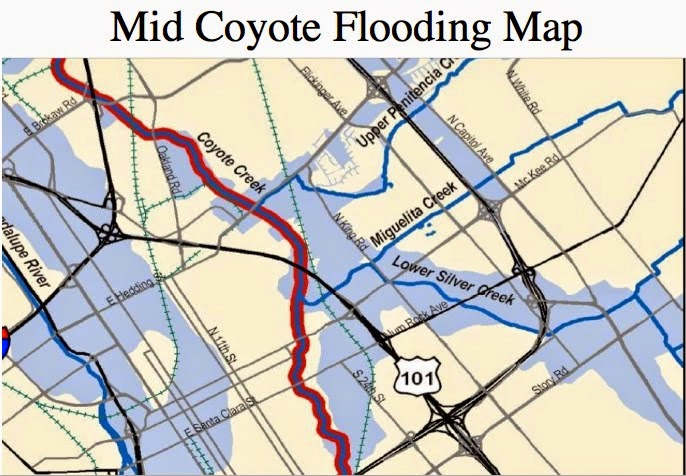
Today, FEMA holds flood insurance policies on thousands of properties throughout Santa Clara/Silicon Valley, where homes and businesses have been constructed in flood plains and bypass channels of our local streams and rivers. Some of those properties are homes adjacent to Coyote Creek in downtown San Jose. The flows through the reach of Mid-Coyote, as the Water District classifies it, have already been augmented by up to 2,000 CFS by a 1974 diversion of seven square miles of the Upper Silver Creek watershed into the Coyote Creek, eight miles upstream of its natural confluence, which is opposite Watson Park near Empire Street.

A few year ago, the Santa Clara Valley Water District designed a flood "protection" project for the Mid-Coyote that would block flood waters from exiting into its natural bypass channels in order to protect homes that have been built there with the blessings of the City of San Jose, FEMA, and the deadly silence of the Water District. One of the benefits listed by the project team is the alleviation of the homeowners located in the bypass channels from having to continue to pay flood insurance premiums, once the bypass channels have been blocked by levees.


While protecting these homes from flooding, the flood water that is prevented from flowing into its natural bypass channels will add another 2000 CFS of water to the main channel of the creek, greatly increasing the velocity and bank erosion of the roaring river at flood stage. Many large eucalyptus trees and other large riparian trees can be expected to fall and form dams at the bridges, and possibly take homes right off the bank, such as those built on the banks downstream of William Street.
It seems that a 35-year old flood diversion channel, built then to protect a new cash register for the City of San Jose called Eastridge, coupled with a flood channelization project that forces even more water into the main channel of the river, in order to protect other homes somewhat remote from the river, is a pretty good case for inverse condemnation of the adjacent creek-side homeowners. Surely these properties will be damaged to a much greater degree when the extra 4000 CFS flows though the main channel of the river, instead of down their natural courses of the Silver Creek to its confluence with Coyote Creek.

The question I raise at this point is this: Should the City of San Jose again fear FEMA and their subrogation lawyers when the next flood occurs in San Jose, and claims are paid by FEMA on homes damaged by the flood that will someday pass through the mid-Coyote?

Tuesday, December 9, 2008

Bottles, Bottles Everywhere, Just to take a Drink

In case you've been living under or in a rock for the last year or so, the ubiquitous plastic water bottles that grew into the hands of many affluent humans during the last decade have quickly become Politically Uncorrect (PU) and most of us are seeking better ways to carry a small convenient container of drinking water around with us. I recently bought six stainless steel bottles from a small company named Nubius Organics in Santa Cruz. We will use these at home and while strolling around the 'hood.

Today I read a bolg post by Mellissa Byer, ranting about a new bottled water called Tap'dNY, which is, as the name implies, botlled municipal New York City tap water. What set off Ms. Byer was the claim on the label that "No Glaciers Were Harmed in the Bottling of this Water." What purity this water represents is offset by the greenwashing spin of this marketing BS that ignores the carbon cost of bottling and then trucking any water to a potential consumer.

This great video produced Quest for KQED in San Francisco puts the plastic water bottle in its proper perspective

There is an inexpensive way for managing the taste and quality of the tap water, which, in our neighborhood, is fairly good quality well water from a well field a few thousand feet downstream on the west bank of Coyote Creek at East Santa Clara Street and South Seventeenth Street. We use a Brita brand carbon filter that fits into a two-part pitcher and lasts about a month and costs about $5.00. This company is a subsidiary of Chlorox, the makers of the disinfectant of choice of most water companies to protect the water while it is in the pipelines from microbial growth, but which also give tap water its bad rap, causing a foul taste. So the same company that causes the problem, also profits in removing it. What a great business plan!

But Chlorox was recently challenged to stop manufacturing a plastic-case filter containing expensive activated carbon that was simply (for them) disposable. A woman in Oakland, CA created a website called TAKE BACK THE FILTER and began collecting used Brita filters to stage a political action/press conference at Chlorox Headquarters during a shareholders meeting. This example of Blessed Unrest has now caused this large corporation to agree to start taking back its filters in January 2009, which may soon lead to the redesign of the filter product to make it easier to deprocess and reuse the components. Actually, as noted on Beth Terry's blog site, Fake Plastic Fish, she reveals that Brita's filters sold in Europe are recyclable, but not those manufactured for consumption in the US. Wasup with that?

To read more about tap water filter options, click here.

Never Thirst!

Friday, December 5, 2008

Michael Pollan for Farmer In Chief

I have written several posts on growing food locally. My last post was on the potential demise of food production in the San Joaquin Valley due to all the salt that's in the irrigation water.

Today I watched the PBS video archive of Bill Moyers interviewing Michael Pollan and encouraging him to accept, if offered, the cabinet post of Secretary of Agriculture in the Obama cabinet.

Instead of suffering through more of my verbosity on the subject of local food production, I encourage you to view this two-part video interview.


Never Hunger, Never Thirst!

Tuesday, November 11, 2008

Salt of the Earth

The San Joaquin Valley is the California poster child for desertification through salinization of its soils from using water from the Federal Central Valley Project. This water contains 2 million tons of salt, applied through out each successive irrigation season.

The oceans are the planetary depository for salt. The continents have been contributing salt to the oceans since rain began to fall from the atmosphere. Humans add their piece to the salt flow with their activities, greatly accelerating the salt flow from certain watersheds.

Industrial agriculture adds enormous salt loads to the receiving waters upstream of the ocean and re-distributes salt downstream through irrigation projects, mainly financed by the federal government.

Twenty five years ago, the State was prepared to build a canal around the eastern edge of the Sacramento-San Joaquin River Delta and thereby reduce this salt load by half and further restrict pumping if salt levels were too high to deliver water during droughts. That essential piece of plumbing was then called the Peripheral Canal and these have become the most dreaded two words in Sacramento.

In response to the State, certain large agricultural interests financed a campaign to stop the Peripheral Canal with a referendum to reverse the state legislative actions which authorized the Department of Water Resources to build the final link in this massive water system. Most support to kill the canal came from the Delta farmers and cotton empires of the Salyer and JG Boswell, built mostly in Tulare Lake and surrounding wetlands. Read excerpts from The King of California here.

With the success of this one ballot measure, San Joaquin Valley farmers fired the poison dart that would steal this 100 year effort by the US Bureau of Reclamation to reclaim these arid lands for production of food and fiber to supply our nation and much of the world. Over the past twenty-five years, the farm lands have been laced with 50 million tons of salt delivered with the irrigation water, twice as salty as it would have been if the Peripheral Can had been built.

It is while these lands are still a viable agricultural resource that we need to act.

I'd like to see California push toward more sustainable agriculture by lowering the salt content of the irrigation water in the San Joaquin Valley rather than watch the land owners salt it in and then develop the salt flats with urbanscape. This means we build the peripheral canal and design it for considerable sea level rise.

Congress should act soon to simply halt all water rights if land use conversion removes it from its agricultural purposes, even if it is due to loss of productivity due to soil pollution. This will create a major shift in protecting our national agricultural resources by making all farmers perpetual stewards of the land, in exchange for a government-developed supply of water.

This proposal would bring the ag lobby to arms like you've never seen it, but it will be good to force them to show their hand (and strong arm behind it!)

George Miller is one of the few members of Congress who could kick off something like this. Congressman Henry Waxman in Southern California could be his strong ally. Senate allies will probably have to come from outside California, as our incumbent Senators Feinstein and Boxer are already owned by the ag lobby.

When the Peripheral Canal was stopped 25 years ago, I started calling the San Joaquin Valley the new Metropolis of SacroBake, home to 30 million future California residents, unable to grow even a backyard garden in this newly created desert, wondering where their next water will come from: the sky or the good graces of the water managers who control any water coming from the ground or aqueducts and still able to pass the health standards set for salinity? Listen to NPR audio track on California Delta Faces Salty Future.

The world may yet mark us down as one more society that crumbled because of mismanaged irrigated agriculture and a self-imposed victim of too much Salt of The Earth.